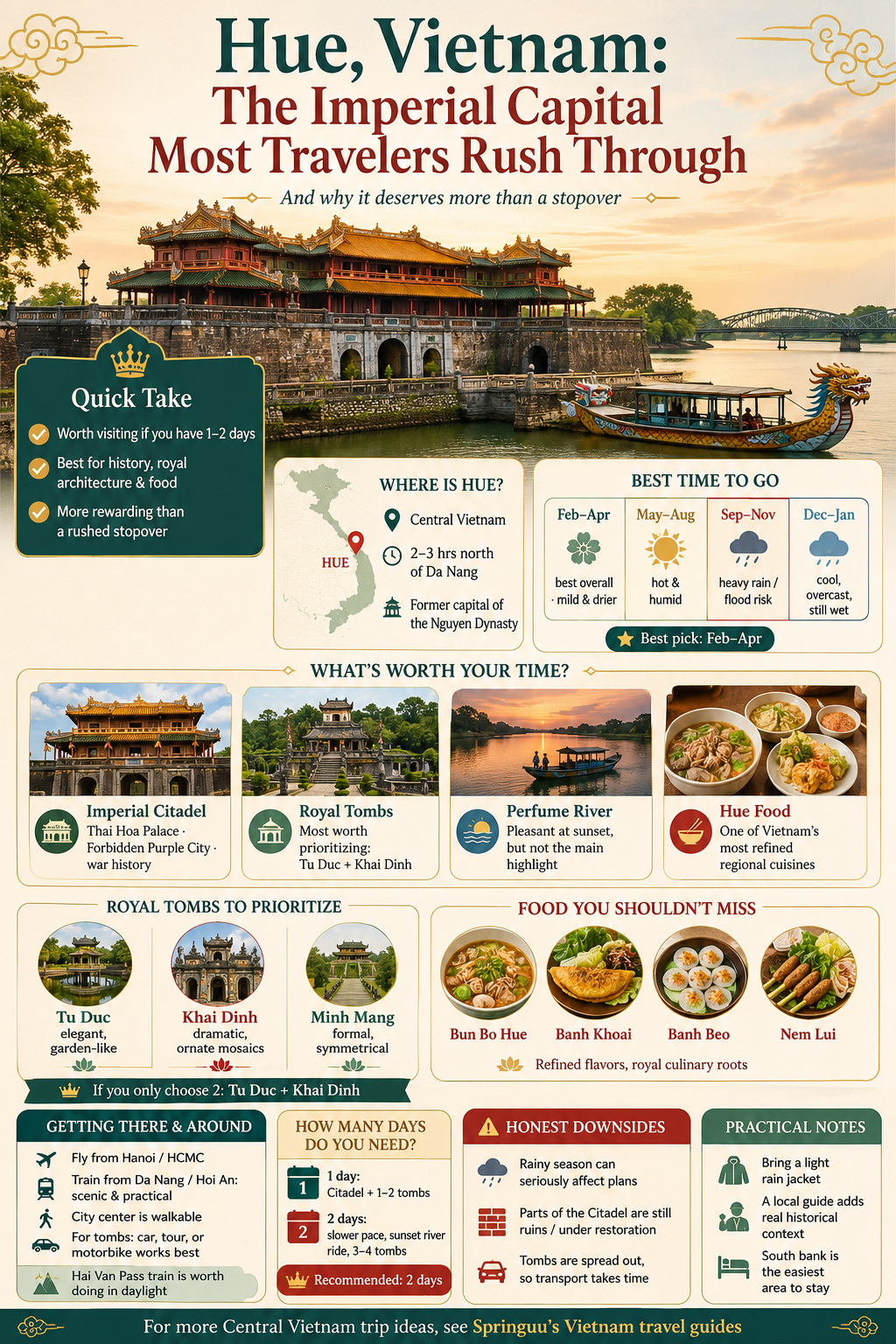
Most itineraries treat Hue as a stopover: a few hours off the train between Hanoi and Da Nang, one rushed loop around the Citadel, then back on the road to Hoi An. That's a shame, because Hue was Vietnam's imperial capital for over a century, and it still carries a quieter, more formal kind of beauty than the beach towns and backpacker streets that get most of the attention.
This guide is for the version of you who has an extra day to spare, or who's tired of doing exactly what every other traveler on the Hanoi-to-Saigon route does. It covers when to go, what's actually worth your time inside the Citadel, which royal tombs deserve a stop, and the honest downsides — because Hue has a rainy season problem that most blog posts gloss over.
Where Is Hue and Why Do So Many Travelers Skip It
Hue sits in central Vietnam, roughly midway between Hanoi and Ho Chi Minh City, and about a 2-3 hour drive north of Da Nang over the scenic Hai Van Pass. It was the seat of the Nguyen Dynasty, Vietnam's last ruling imperial family, from the early 1800s until 1945. Because it sits between two more Instagram-friendly stops — Hoi An's lantern-lit old town and Ha Long Bay's limestone cliffs — Hue often gets compressed into a half-day layover instead of a proper visit, which undersells what's actually here.
The Best Time of Year to Visit Hue
This is the part most guides don't say plainly enough: central Vietnam, including Hue, has a genuinely wet rainy season, and it can affect your trip more than people expect. The table below is a rough guide — actual conditions vary year to year.
Inside the Imperial Citadel: What You're Actually Looking At
The Imperial Citadel (Kinh Thanh Hue) is a walled complex modeled loosely on Beijing's Forbidden City, built to house the Nguyen emperors and their court. Large sections were damaged during the Vietnam War, particularly during the 1968 Tet Offensive, and what you see today is a mix of restored halls, open foundations where buildings once stood, and a few sections still under active restoration. The Thai Hoa Palace and the Forbidden Purple City area are the most complete parts. Go in expecting a place layered with both imperial grandeur and visible war history — it reads differently than a fully-restored tourist replica, and that's part of what makes it worth a slower visit rather than a fast walkthrough.
The Royal Tombs: Which Ones Are Worth Your Time
Scattered along the Perfume River outside the city center are the tombs of several Nguyen emperors, each built in a distinct architectural style reflecting that emperor's personality. You won't have time — or patience — for all of them in one visit, so it helps to know the differences. Tu Duc's tomb is often considered the most elegant, set among pine trees and a lake, closer to a private retreat than a mausoleum. Khai Dinh's tomb is the most visually dramatic, blending Vietnamese and European architectural elements with elaborate mosaic work inside. Minh Mang's tomb is the most formally symmetrical, laid out like a classical garden complex. If you only have time for two, Tu Duc and Khai Dinh give you the widest contrast.
A Boat Ride on the Perfume River, Honestly Assessed
Dragon boat rides on the Song Huong (Perfume River) are heavily marketed to tourists, and the honest take is that the boat ride itself is pleasant but not the highlight — it's mostly a transport method between riverside sites, occasionally paired with a folk music performance that feels more staged than spontaneous. It's worth doing once for the atmosphere, especially near sunset, but don't expect it to be the standout memory of your Hue visit.
Hue's Food Scene: Vietnam's Most Refined, Least Known Cuisine
Hue has a reputation among Vietnamese food lovers as home to some of the country's most refined regional cooking, a legacy of its imperial court cuisine tradition. Bun bo Hue, the spicy beef and pork noodle soup, is the city's signature dish and noticeably different from the Hanoi or Saigon versions of noodle soup — more complex, more chili-forward, with a distinct lemongrass and shrimp paste base. Banh khoai, a crispy turmeric pancake similar to but smaller than the southern banh xeo, is another local specialty, along with a whole category of small, delicate dishes originally designed for the royal court, like banh beo (steamed rice cakes) and nem lui (grilled lemongrass pork skewers). Food here tends to be more elaborate in presentation than in central or southern Vietnam generally.
Getting to Hue and Getting Around
Hue has its own airport with domestic connections to Hanoi and Ho Chi Minh City, and it's a stop on the north-south reunification railway line, making the train from Da Nang or Hoi An (roughly 2.5-3 hours) a scenic and practical option. Within the city, the Citadel and central areas are walkable, but the royal tombs are spread out along the river outside town, so most visitors hire a car, join a group tour, or rent a motorbike to cover them in a day.
Where to Stay in Hue
Most visitors base themselves on the south bank of the Perfume River, in the newer part of the city near hotels, restaurants, and riverside cafes, which puts you a short walk or cheap taxi ride from the Citadel on the north bank. Staying right along the river gives you easy evening walks and sunset views without needing transport, which is a small but genuinely nice convenience if you're only in Hue for a day or two and don't want to waste time commuting between your hotel and the sights.
How Many Days Do You Actually Need
A rushed visit can cover the Citadel highlights and one or two tombs in a single very full day. But two days lets you actually slow down — spend a proper morning in the Citadel without rushing, take an unhurried boat ride at sunset, and visit three or four tombs without feeling like you're checking boxes. If your itinerary allows it, two days in Hue is a meaningfully better experience than one.
The Honest Downsides of Visiting Hue
Beyond the rainy season risk mentioned above, it's worth being upfront about a few other things. Large parts of the Citadel are still ruins or under restoration, so if you're expecting a fully rebuilt palace complex like some other Asian imperial sites, temper that expectation. The tombs are spread out enough that getting between them without a driver or tour can eat up a lot of your day. And because Hue sees less tourist infrastructure investment than Hoi An or Da Nang, some sites feel a little less polished — which some travelers find charming and others find underwhelming, depending on what you're looking for.
A Few Practical Notes Before You Go
Hue's weather swings enough between seasons that packing a light rain jacket is worth doing regardless of when you visit, since even the drier months can bring a passing shower. English signage at the major sites is decent, but a local guide adds real value here specifically because so much of Hue's story is tied to events — the fall of the Nguyen Dynasty, the 1968 Tet Offensive fighting inside the Citadel walls — that aren't always explained in much depth on the information placards alone. If you're combining Hue with Hoi An or Da Nang, the train ride over the Hai Van Pass between Hue and Da Nang is worth doing during daylight hours purely for the coastal scenery, rather than an overnight bus that skips it entirely.
Frequently Asked Questions
What is the best time of year to visit Hue?
February through April generally offers the most comfortable weather. September through November is the peak rainy season and carries a real risk of heavy rain or flooding disrupting travel plans, so it's worth checking forecasts closely if you're traveling in that window.
How many days should I spend in Hue?
One full day covers the highlights, but two days lets you visit the Citadel without rushing and see three or four royal tombs at a comfortable pace rather than racing between sites.
Is the Perfume River boat ride worth doing?
It's a pleasant way to spend part of an afternoon or evening, especially near sunset, but it's not the standout experience of a Hue visit — think of it as a nice addition rather than a must-do centerpiece.
Which royal tombs should I prioritize if I don't have time for all of them?
Tu Duc's tomb (elegant, garden-like) and Khai Dinh's tomb (dramatic, ornate mosaic work) offer the widest contrast in style if you only have time for two.
Is the Imperial Citadel fully restored?
No, and that's worth knowing before you go. Large sections were damaged during the Vietnam War, and parts of the complex remain ruins or are still under active restoration alongside the fully restored halls.
For more help planning a central Vietnam route or finding a local guide who knows Hue beyond the tourist checklist, check out Springuu's Vietnam travel guides.