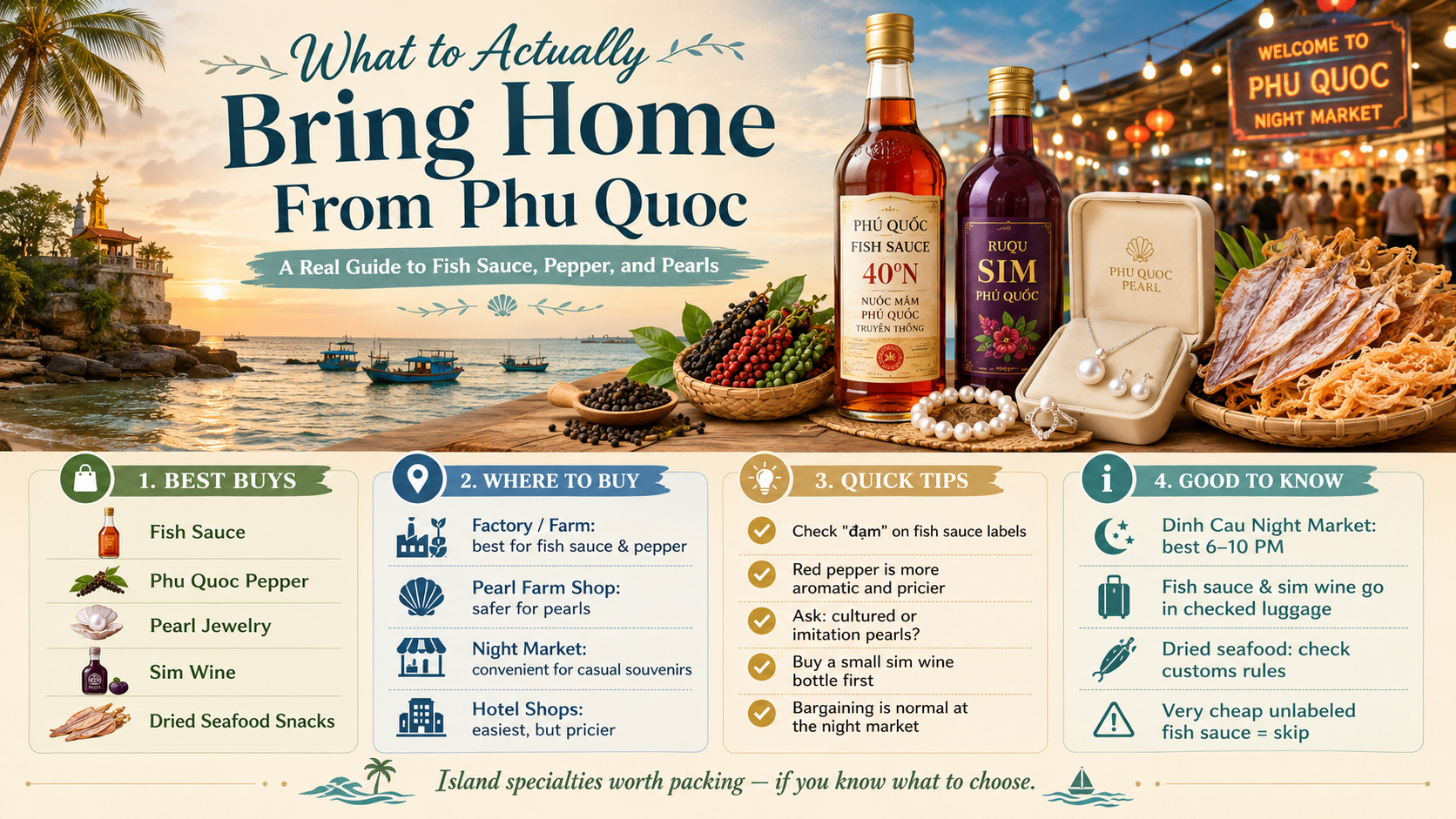
Most souvenir shopping in Vietnam revolves around the same handful of items: coffee, cashews, dried mango, maybe a silk scarf. Phu Quoc breaks that pattern. This island off the southern coast has its own specialties shaped entirely by geography — fish sauce brewed in wooden barrels along the coastline, pepper farms tucked into the interior, and pearl farms in the surrounding waters. Walk through the night market here and the smell alone tells you you're somewhere different.
For travelers flying in from Taiwan or elsewhere, Phu Quoc souvenirs are worth planning for a little differently than a mainland Vietnam trip. Some of what's sold here is genuinely island-specific and hard to find elsewhere. Some of it is generic tourist merchandise dressed up with island branding. This guide is based on actually walking the night market, a couple of fish sauce producers, and a pepper farm, sorting out what's worth the suitcase space and what isn't.
Why Phu Quoc Souvenirs Are Different From the Rest of Vietnam
Phu Quoc sits in the Gulf of Thailand, closer to Cambodia than to most of mainland Vietnam, and its economy has historically centered on fishing and, more recently, tourism. That geography produces a specific set of local goods: fish sauce made from anchovies caught in nearby waters, pepper grown in the island's laterite soil, and pearls cultivated in the calm coastal bays. None of these are unique to Phu Quoc in the sense that Vietnam doesn't produce them elsewhere, but the island's version of each has a distinct reputation among Vietnamese shoppers themselves, which is usually a decent sign something is worth trying.
Fish Sauce (Nước Mắm Phú Quốc): What Makes It Different and How to Choose a Bottle
Phu Quoc fish sauce has a protected geographical indication in Vietnam, similar in concept to Champagne or Parmesan — meaning genuine Phu Quoc-labeled fish sauce is supposed to be produced on the island using a traditional method of fermenting anchovies in wooden barrels for around a year. The color should be a deep amber-brown, and the better bottles list a protein content (đạm) on the label — generally, a higher number indicates a stronger, more traditionally fermented sauce, though it also comes with a higher price and a very strong smell that takes some getting used to. Lower-grade bottles are diluted and sweetened, which is fine for cooking but not quite the "real" experience. If you can, visit one of the fish sauce factories near Duong Dong town, where you can see the barrels and buy directly — it's usually cheaper than buying the same bottle at a hotel gift shop.
Phu Quoc Pepper: Black, Red, or the Rare Wild Variety
Pepper farming is a genuine local industry on Phu Quoc, and the island's pepper has a reputation within Vietnam for being more aromatic than pepper grown on the mainland, largely attributed to the island's soil and climate. You'll typically find black pepper (fully dried), red pepper (harvested ripe, slightly sweeter and more expensive), and occasionally green or "wild" pepper sold in smaller batches at a premium. A small jar or bag of red peppercorns makes a compact, lightweight souvenir that most people will actually use, unlike a lot of decorative trinkets that end up in a drawer.
Pearl Jewelry: What's Real, What's Cultured, and How Not to Overpay
Phu Quoc has several pearl farms open to visitors, and pearl jewelry is heavily marketed around the island. Almost everything sold as "pearl" here is cultured, not wild — that's completely normal and not a scam in itself, since wild pearls are vanishingly rare worldwide. The issue is quality variation: some cultured pearls sold in market stalls are actually shell-based imitation pearls with a thin coating, not real cultured pearls at all. A rough rule of thumb is that genuine cultured pearls have slight surface irregularities and vary a bit in size and shape, while imitation pearls tend to look suspiciously uniform and perfectly round. If you're spending real money on a piece, buying from a pearl farm shop with a visible farming operation is safer than a random market stall, and it's worth asking directly whether what you're buying is cultured or imitation — a straightforward answer is usually a decent sign.
Sim Wine: The Island's Berry Wine Worth Trying (and Its Limits)
Sim wine is made from a local berry (rose myrtle) that grows wild on Phu Quoc's hillsides, and it has become one of the island's signature souvenir products — sweet, low-to-moderate alcohol content, and sold everywhere from the night market to the airport. It's worth trying, but it's genuinely a niche taste: closer to a sweet fruit liqueur than a wine most people would recognize, and quality varies a lot between producers. Cheaper bottles can taste artificially sweet or overly syrupy. If you like it, buy a smaller bottle to test before committing to a full-size one as a gift for someone whose taste you're not sure of.
Phu Quoc Night Market: What's Worth Buying vs What's Just for Tourists
The Dinh Cau Night Market in Duong Dong is the main tourist shopping and eating spot on the island, busiest from around 6 to 10pm. It's genuinely good for fresh seafood dinners and casual souvenir shopping — dried squid, pepper, small bottles of fish sauce, sim wine, and inexpensive clothing. What's less worth it here is the jewelry and "coral" or "shell craft" stalls, where quality is inconsistent and prices for tourists tend to run higher than at a dedicated shop. As with most tourist markets in Vietnam, starting prices are often inflated, and a bit of polite bargaining, especially on non-food items, is normal and expected.
Dried Seafood and Squid: A Great Gift, With One Catch
Dried squid, shrimp, and other seafood snacks are popular, affordable, and genuinely local to an island economy built on fishing. The catch, literally, is smell and customs — dried seafood has a strong odor that can linger in luggage, and some countries have restrictions on bringing dried seafood products through customs. It's worth checking Taiwan's current import rules for dried seafood before loading up, since regulations do change and getting this wrong at the airport is a bigger headache than just skipping the purchase.
Packing Liquids Home: Fish Sauce, Sim Wine, and Airline Rules
Fish sauce and sim wine are both liquids, which means they need to go in checked luggage, not carry-on, due to standard airline liquid restrictions. Wrap glass bottles well — bubble wrap or clothing padding works, and a sealed plastic bag around the cap prevents a leak from ruining the rest of your suitcase if the seal isn't perfect. If you're buying sim wine, also check your airline's alcohol volume and quantity limits before buying multiple bottles, since these vary by carrier and by the alcohol percentage of the drink.
Where to Buy: Farms and Factories vs Market Stalls vs Hotel Shops
For fish sauce and pepper especially, buying directly from a producer — a fish sauce factory near Duong Dong, or a pepper farm in the island's interior — tends to get you fresher stock, clearer information about what you're buying, and often a better price than the same bottle sold at a hotel gift shop with a large markup. The night market sits in between: convenient and reasonably priced for casual souvenirs, but not the place to spend serious money on pearls or premium fish sauce. Hotel shops are the most convenient but generally the most expensive option across the board.
Common Tourist Traps on Phu Quoc You Should Know About
Being honest here: some market stalls sell "fish sauce" in unlabeled or vaguely labeled bottles at suspiciously low prices — this is usually diluted, low-grade sauce, not the real Phu Quoc product, regardless of what the vendor claims. Similarly, imitation pearl jewelry gets sold as "genuine cultured pearl" often enough that it's worth staying skeptical of any deal that feels too good, especially from a stall without a visible farm or workshop behind it. None of this means you'll get scammed on Phu Quoc — most transactions are perfectly fine — but going in with reasonable skepticism about unusually low prices will save you disappointment later.
If you're planning a longer Vietnam itinerary beyond Phu Quoc, Springuu's Vietnam travel guides cover more destinations in depth, and a local guide who actually knows the island's producers can save a lot of trial and error compared to figuring it out alone.
Frequently Asked Questions
Can I bring fish sauce home in checked luggage?
Yes, but it needs to go in checked luggage rather than carry-on since it's a liquid. Wrap the bottle well and seal the cap in a plastic bag as a precaution against leaks during transit.
How do I know if Phu Quoc pearls are real?
Almost all pearls sold on Phu Quoc are cultured rather than wild, which is normal. The bigger question is whether it's a genuine cultured pearl or an imitation shell-based bead — genuine ones usually have slight surface irregularities, while imitations tend to look suspiciously uniform. Buying from a pearl farm shop and asking directly is the safer route.
What's the best time to visit Phu Quoc's night market?
The Dinh Cau Night Market is busiest and most fully stocked between roughly 6 and 10pm. Going earlier means fewer crowds but some food stalls may not be fully set up yet.
Is Phu Quoc pepper actually different from pepper grown elsewhere in Vietnam?
Within Vietnam, Phu Quoc pepper has a strong local reputation for being more aromatic, generally attributed to the island's soil and climate. It's a genuine regional specialty, though whether the flavor difference is dramatic enough to notice will depend on how attuned your palate is to pepper in the first place.
What's a common souvenir scam on Phu Quoc?
Unlabeled or vaguely labeled "fish sauce" sold cheaply at some market stalls is often diluted or low-grade rather than genuine Phu Quoc fish sauce. It's worth being cautious of deals that seem unusually cheap, particularly for fish sauce and pearl jewelry, and buying from producers or shops with a visible, verifiable operation when the purchase matters to you.