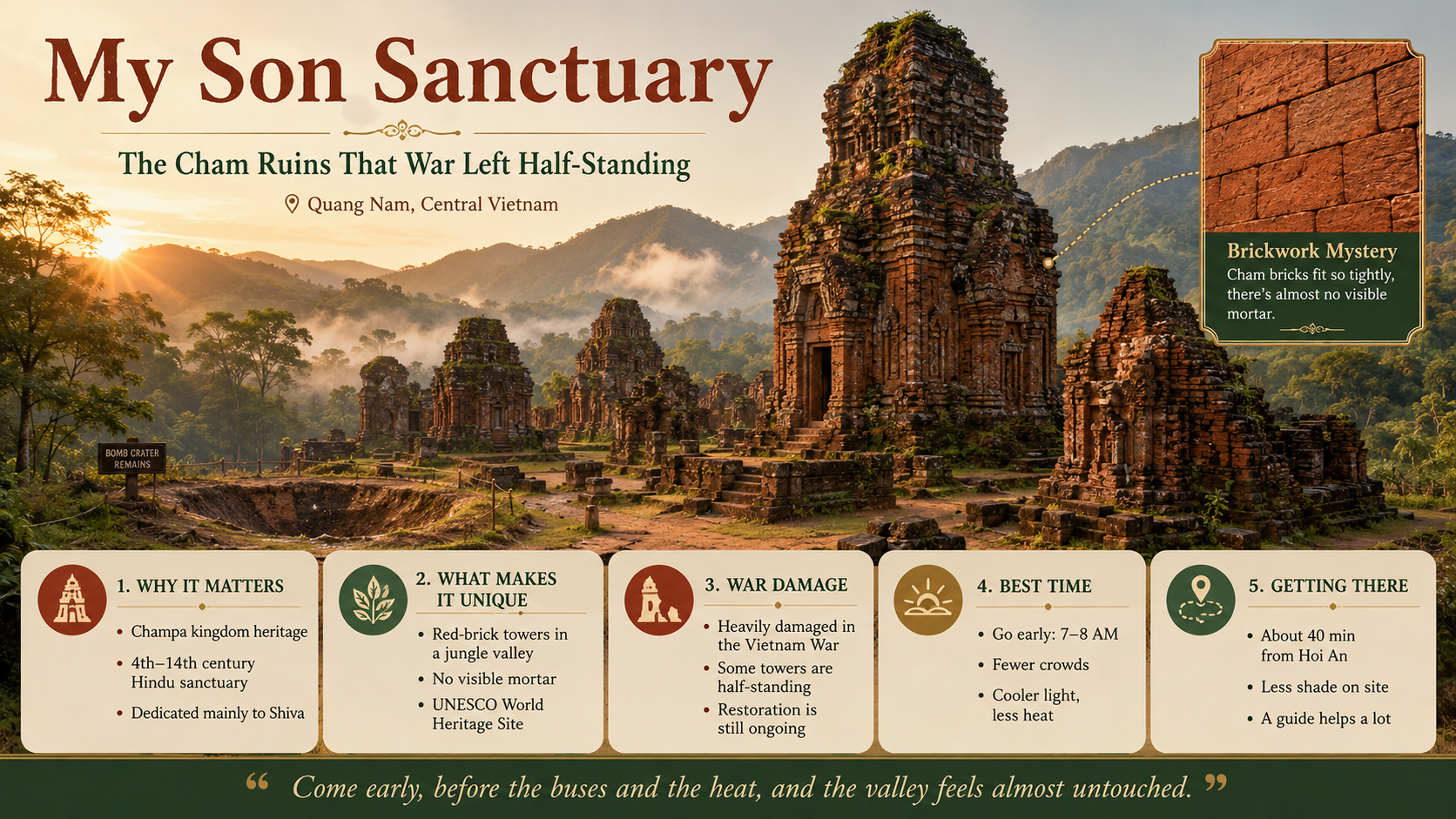
The road to My Son cuts through rice paddies for almost forty minutes before the land starts to fold into hills. Then the valley opens up — jungle-covered mountains on every side, and in the middle of it, red brick towers rising out of the mist like they grew there. It's early, just past 7am, and the tour buses haven't arrived yet. For maybe twenty minutes, it's just you, the sound of insects, and structures that have been standing here since before Angkor Wat existed.
A Hindu Kingdom Vietnam Doesn't Talk About Enough
My Son was the religious capital of the Champa kingdom, a Hindu civilization that ruled central Vietnam for over a thousand years. The towers here were built between the 4th and 14th centuries, dedicated mostly to Shiva. Most visitors to Vietnam never hear about Champa at all — the country's history books tend to focus on the Vietnamese dynasties further north, and Champa gets a footnote. Standing in front of towers that predate most of Hanoi's monuments by centuries changes that footnote fast.
What the Bombs Left Behind
Here's the part that's hard to write around: My Son was heavily damaged by American bombing during the Vietnam War, because North Vietnamese forces used the dense jungle around the ruins as a base. One crater is still visible near the main cluster of towers, and several structures are missing entire walls. If you're picturing something as intact as Angkor Wat, adjust that expectation now — a meaningful part of what makes My Son worth visiting is seeing a UNESCO site that's still, quite literally, a work in progress, with restoration teams from Vietnam, Italy, and India still piecing sections back together.
The Mortar No One Can Explain
One genuine mystery that archaeologists still argue about: the Cham builders stacked these bricks without any visible mortar, and the joints are so tight you can barely fit a blade between them. Some researchers think they used a resin from a local tree, others think the bricks were fired after assembly. Nobody has fully cracked it. It's the kind of detail a guidebook glosses over in one line, but standing close enough to run your finger along a nearly invisible seam makes it land differently.
Go Early, Skip the Heat
My Son sits about 40 minutes from Hoi An by car, a bit less from Da Nang. There's almost no shade among the ruins, and central Vietnam's midday sun by 10am is no joke. Tour groups tend to arrive around 8:30-9am, so if you can get there right at opening, you get the towers mostly to yourself before the day heats up and the crowds do too.
If you want someone who can actually explain what you're looking at — the difference between a kalan and a mandapa, which tower survived and which didn't, why the mortar mystery matters — the local guides at Springuu are worth talking to. They're Vietnamese, they live here, and they know things that don't show up on any travel blog.
Frequently Asked Questions
How far is My Son from Hoi An?
About 40 minutes by car, roughly 30-35km depending on the route. Most visitors combine it with a half-day trip from Hoi An or Da Nang.
Is My Son as well-preserved as Angkor Wat?
No, and it's worth knowing that before you go. War damage from the 1960s left several towers partially destroyed, including a bomb crater still visible near the main group. Restoration is ongoing but incomplete — the appeal is different from a fully intact site.
What's the best time to visit?
Right at opening, around 7-8am, before tour buses arrive and before the heat sets in. There's very little shade on site.
Do I need a guide to appreciate My Son?
You don't need one, but the ruins have minimal on-site signage, and a lot of the history — the Champa kingdom, the construction techniques, what survived the war and what didn't — isn't explained without one.