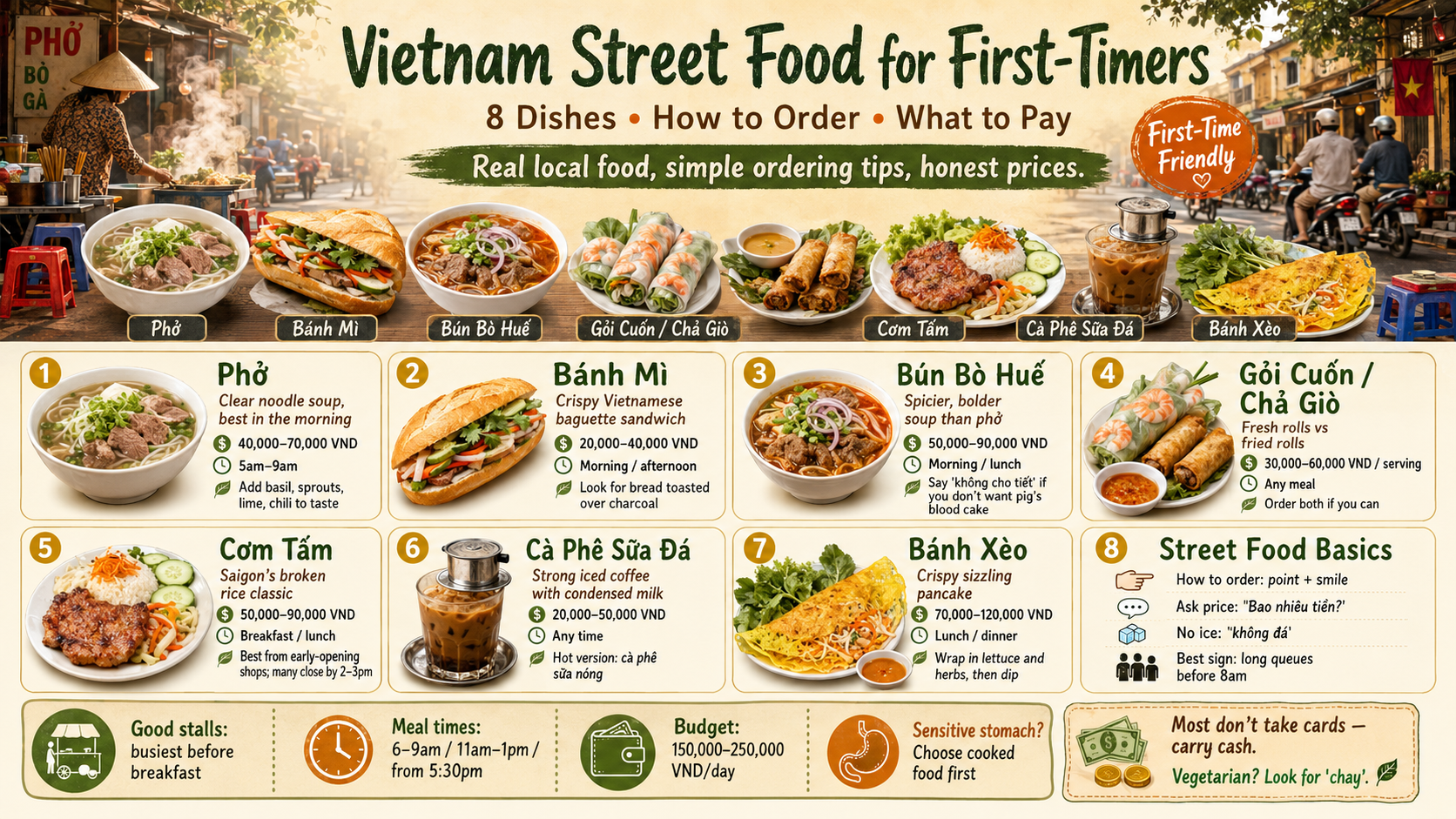
Vietnam's street food is one of those things that sounds straightforward until you're standing in front of twelve different soup stalls at 7am, none of which have English menus, and you realize you don't know what any of the dishes are called or how they're eaten differently from each other.
This guide exists for that exact situation. It covers the eight dishes a first-time visitor to Vietnam is most likely to encounter, what they actually taste like, how to eat them correctly, and what they cost — without the superlatives and vague enthusiasm that make most food guides useless.
Phở: Not What Most People Expect
Phở (pronounced closer to "fuh" than "foe") is a clear broth soup served with flat rice noodles and either beef or chicken. The broth is made by simmering bones for many hours with star anise, cinnamon, charred ginger, and onion — which is why it smells the way it does, and why it takes a while to get right.
What most visitors don't know: phở is a breakfast dish. The best phở in Vietnam is eaten between 5am and 9am at a small shop that's been open since your grandparents' generation. By 11am, the broth has cooked down and the shop is often out of the better cuts of meat. Order phở at dinner from a tourist-facing restaurant and you'll get a competent version of it, but not the real thing.
Also: in Ho Chi Minh City, phở comes with a plate of bean sprouts, Thai basil, lime, and chili — these are not garnish, they're part of the dish, and you add them yourself according to your preference. In Hanoi, the bowl arrives mostly as-is, with less accompaniment and a cleaner broth. Both styles are worth trying. They're meaningfully different.
Expect to pay: 40,000–70,000 VND (roughly $1.60–$2.80) | Best time: early morning
Bánh Mì: The Sandwich That Shouldn't Work but Does
A bánh mì is a Vietnamese baguette — thinner and crispier than a French baguette — filled with a combination of pork liver pâté, cold cuts, pickled daikon and carrot, cucumber, cilantro, and chili. The French left their bread; the Vietnamese made it into something better.
The range of quality is enormous. A good bánh mì has bread that crunches when you bite it, pâté that's been properly seasoned, pickled vegetables with actual tang, and enough chili to notice. A bad one is just soft bread with some bland protein inside. The difference is usually visible before you bite: look for a vendor who's toasting the bread over a small wire rack above charcoal before they fill it.
Price: 20,000–40,000 VND. It's the cheapest meal in the country and sometimes the best one.
Expect to pay: 20,000–40,000 VND | Best time: morning or afternoon
Bún Bò Huế: The Soup Most Tourists Miss
Most travelers know phở. Fewer know bún bò Huế, which is a shame, because it's arguably more interesting. It's a thick, spicy broth made with lemongrass, shrimp paste, and chili, served over thicker round rice noodles with beef, pork knuckle, and pig's blood cake.
The flavor is more aggressive than phở — the lemongrass gives it a floral note, the shrimp paste gives it depth, and the chili gives it heat that builds as you eat. It comes from Huế, the former imperial capital in central Vietnam, but you can find it throughout the country.
If the pig's blood cake makes you hesitate, you can ask for it without: "không cho tiết" (không cho tee-et). The dish is still worth eating without it. If you've been eating phở every morning and you want to try something structurally similar but completely different in character, this is where to go next.
Expect to pay: 50,000–90,000 VND | Best time: morning or lunch
Gỏi Cuốn vs Chả Giò: The Two Spring Rolls
Vietnam has two spring rolls, and they are not interchangeable. Gỏi cuốn (fresh spring rolls) are uncooked: rice paper wrapped around shrimp, pork, vermicelli, lettuce, and mint, served with a peanut or hoisin dipping sauce. They're light, cold, and refreshing. Chả giò (fried spring rolls) are deep-fried until the rice paper wrapper turns crackling and golden, filled with pork, mushroom, and glass noodles, served with a sweet fish sauce dip. They're hot, crispy, and substantial.
Order both if you can — they're usually available at the same restaurant and they're cheap enough that you won't regret it. Gỏi cuốn is better in warm weather and as a starter. Chả giò is better alongside a main meal or as a snack with beer.
Expect to pay: 30,000–60,000 VND per serving | Best time: any meal
Cơm Tấm: The Broken Rice Dish That's Actually Famous
Cơm tấm means "broken rice" — the grains are smaller, slightly fragmented, and have a different texture than regular steamed rice. It's a dish specific to Ho Chi Minh City, and it's eaten for breakfast and lunch, not dinner.
The full version comes with a grilled pork chop (sườn nướng) that's been marinated overnight in fish sauce, sugar, and garlic, plus shredded pork skin (bì), steamed pork and egg cake (chả trứng), and fried shallots. Everything sits over the rice and you pour a clear fish sauce dressing over the whole thing.
The combination sounds like a lot for breakfast, and it is — it's filling and savory and slightly sweet in that distinctly southern Vietnamese way. The best cơm tấm shops open early and close when they run out, often by 2pm. If you're in Ho Chi Minh City and you want to understand how locals eat, this is a better introduction than the average restaurant menu.
Expect to pay: 50,000–90,000 VND | Best time: breakfast and lunch only (most shops close by 2–3pm)
Cà Phê Sữa Đá: The Coffee Worth Understanding
Vietnamese iced coffee with condensed milk (cà phê sữa đá) is not just a drink, it's a cultural practice. Coffee drips slowly through a small metal filter into a glass with a spoonful of condensed milk at the bottom. You stir, add ice, and drink something that is simultaneously very bitter and very sweet, with a syrupy thickness that's different from anything you'd get at a café in most other countries.
Vietnam is one of the largest coffee producers in the world, and the variety grown here (robusta) is higher in caffeine and more bitter than the arabica beans used in most Western coffee. The condensed milk exists in part to cut that bitterness.
You can order it hot (cà phê sữa nóng) or iced (cà phê sữa đá). The iced version is standard in the south; in Hanoi, you might also encounter egg coffee (cà phê trứng) — whipped egg yolk and sugar beaten into a thick foam on top of black coffee — which sounds strange and tastes genuinely good.
Expect to pay: 20,000–50,000 VND at a local café | Best time: any time, but morning is traditional
Bánh Xèo: The Sizzling Pancake
The name means "sizzling cake," which describes the noise the rice flour batter makes when it hits the hot pan. The pancake is made with rice flour, turmeric (which gives it the yellow color), and coconut milk, filled with shrimp, bean sprouts, and pork belly, then folded in half and served with a heap of raw lettuce leaves and herbs.
The eating method is unusual: you tear off a piece of the pancake, place it inside a lettuce leaf with some herbs, roll it up into a package, and dip the whole thing into nước chấm (the sweet-sour-salty-spicy fish sauce that appears with most Vietnamese food). The combination of crispy pancake, cold fresh herbs, and the punchy dipping sauce works in a way that's hard to explain until you've done it.
In Ho Chi Minh City, the pancakes are large — big enough to share between two people. In the central provinces, they're smaller, more delicate, sometimes greasier. Both versions are worth eating.
Expect to pay: 70,000–120,000 VND | Best time: lunch or dinner
Practical Things No One Tells You
How to find good street food without a guide
The most reliable signal is queue length before 8am. The best street food stalls in Vietnam don't need marketing — they've had the same customers for twenty years, and those customers show up early. If there's a line, join it.
How to ask about price
"Bao nhiêu tiền?" means "how much?" Say this before you sit down at any stall that doesn't have posted prices. Most vendors will tell you honestly. Some won't. Knowing the question at least changes the dynamic.
What to do if you can't read the menu
Point at what someone near you is eating, hold up one finger, and nod. This works in essentially every restaurant and food stall in the country.
About the ice in drinks
Most ice in Vietnamese cities is commercially produced in sealed bags and is safe. The risk goes up at small roadside stalls using handmade block ice. If you're cautious, you can ask for drinks without ice: "không đá."
Meal timing
Vietnamese eating times are earlier than most Western visitors expect. Breakfast is 6–9am, lunch is 11am–1pm, and dinner starts around 5:30pm. Many street stalls that specialize in one dish are sold out or closed by 2pm. Plan accordingly.
Frequently Asked Questions
Q: Is Vietnamese street food safe to eat for most travelers?
Generally yes, with caveats. Busy stalls with high turnover are lower risk because ingredients don't sit out long. The main issues tend to be with raw vegetables and poorly maintained ice, not the cooked food itself. If you have a sensitive stomach, stick to cooked dishes and bottled or canned drinks for the first day or two while you adjust.
Q: How much should I budget for food per day in Vietnam?
Eating only street food and local restaurants, 150,000–250,000 VND per day (roughly $6–10) covers three meals comfortably. Adding café stops and the occasional proper restaurant, 300,000–500,000 VND ($12–20) is a generous daily food budget.
Q: Can I eat vegetarian or vegan in Vietnam?
Yes, but it requires some effort. Look for stalls or restaurants with "chay" (vegetarian) in the name — Buddhist vegetarian cooking is well-developed in Vietnam, especially in central Vietnam. At regular restaurants, fish sauce appears in most dishes, including salads, so ask if you need to avoid it: "không cho nước mắm" (no fish sauce).
Q: Is it rude to not finish your food at a Vietnamese restaurant?
Not particularly — leaving food is not considered as offensive as in some other Asian cultures. What matters more is ordering politely and not bargaining aggressively over food prices. Paying what the stall asks without a confrontation is the norm and the right call for small food purchases.
Q: What's the one dish I absolutely shouldn't miss?
If forced to choose one, cơm tấm in Ho Chi Minh City, for breakfast, from a stall with locals eating it. It's specific enough to a time and place that you can only get it right there — which is what makes it worth seeking out.