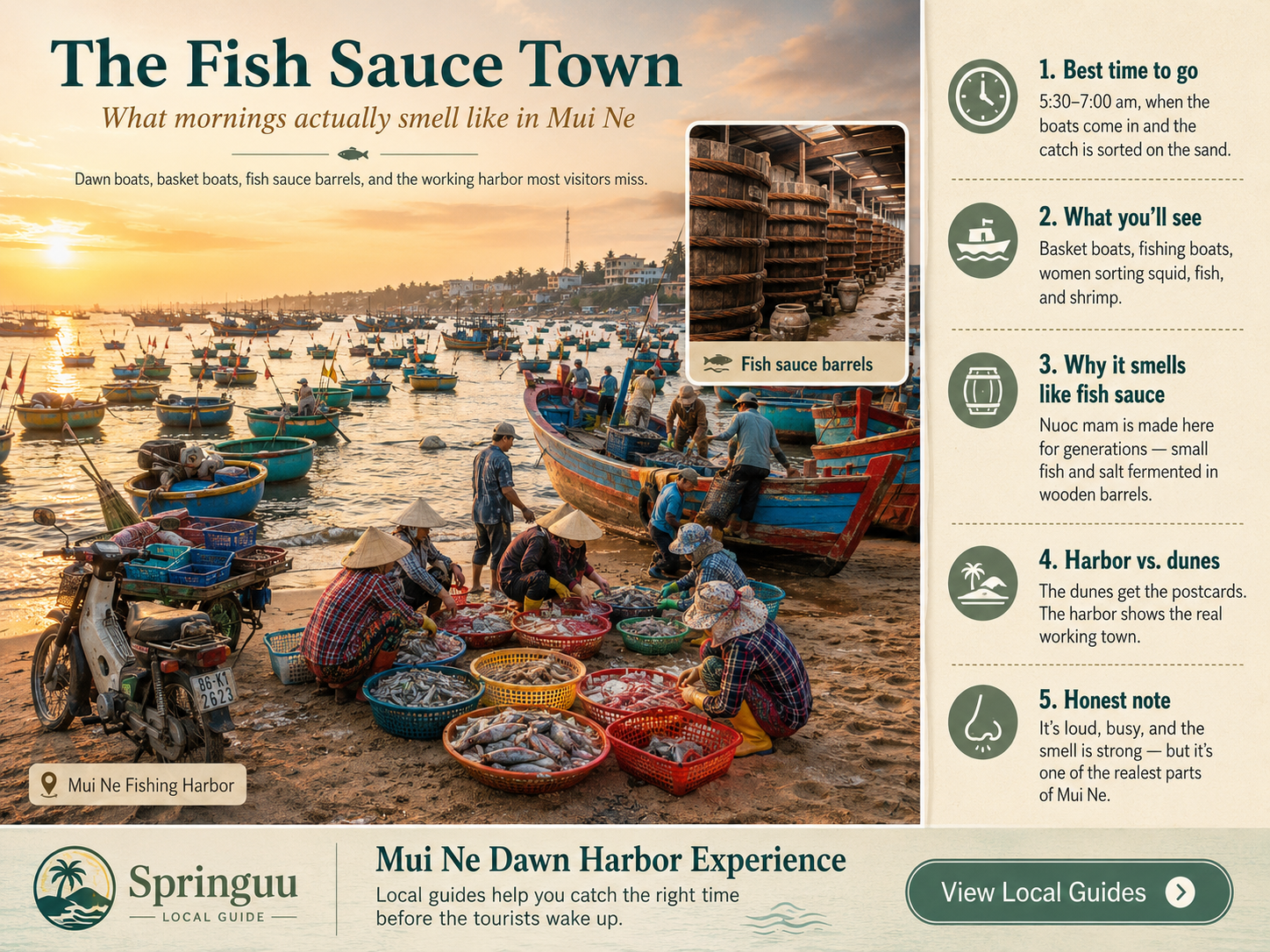
The smell hits before the boats are even in sight — salty, sharp, a little fermented, not unpleasant once you know what it is. It's nuoc mam, Vietnamese fish sauce, and in Mui Ne it's not a condiment on a shelf. It's the smell of the whole town waking up.
I got up at 5am for this, mostly out of curiosity. Mui Ne gets sold as sand dunes and beach resorts now, but long before that, it was — and still is — a working fishing village. The boats come in around dawn, and that's when the place actually shows you what it is.
View Mui Ne Guide Profiles→
The boats come in before the tourists wake up
Dozens of round, brightly painted basket boats bob just offshore, and bigger wooden fishing boats line up closer to the beach to unload. Women wait on the sand with plastic baskets and quick hands, sorting the catch — squid, small fish, shrimp — almost before it's fully on shore. There's shouting, bargaining, the occasional motorbike riding straight onto the sand to haul fish away. None of it is staged for visitors. Most tourists are still asleep.
Why this town smells like fish sauce
Mui Ne and the nearby town of Phan Thiet have made nuoc mam for generations — small fish layered with salt in wooden barrels, left to ferment for months until it turns into the deep amber liquid that ends up on every table in Vietnam. You can still see rows of barrels near the fishing harbor, and if the wind is right, you'll smell the fermentation before you see it. It's strong. It's not for everyone. But it's also one of the realest things about this town, more than any beach photo.
The dunes get the postcards, the harbor gets the truth
Almost every photo of Mui Ne online looks the same: red or white sand dunes at sunset, smoothed out, golden light. They're real and worth seeing, but they're maybe twenty minutes of the actual experience — and they get crowded with jeep tours by late afternoon. The fishing harbor at dawn is the part nobody photographs for Instagram, and honestly, it's the part that stayed with me longer.
Being honest about the parts that are hard to love
I won't pretend the harbor is pleasant in the way a resort beach is. It's loud, the sand near the boats isn't the clean white sand from the brochures, and the fish sauce smell is genuinely strong enough that some travelers turn around after five minutes. If strong smells bother you, keep the visit short, stay upwind, and don't expect a postcard moment. What you get instead is something closer to how the town actually runs.
If you want someone who actually knows where the good stuff is, the local guides at Springuu are worth talking to — they're Vietnamese, they live here, and they know things that don't show up on any travel blog.
View Local Guides
Guide Prices
English-speaking Guides
Frequently Asked Questions
What time should I go to see the fishing harbor?
Around 5:30 to 7am, when the boats come in and the catch gets sorted on the beach. By mid-morning, the activity dies down.
Does Mui Ne really smell like fish sauce?
Yes, especially near the harbor and the fermentation barrels. It's strong and not for everyone — if you're sensitive to it, keep your visit short.
Is the fishing harbor safe and easy to visit on your own?
It's generally safe, but it's a working harbor, not a tourist site — boats, baskets, and motorbikes move fast and nobody slows down for visitors, so watch your footing and stay out of the way.
Is Mui Ne worth visiting beyond the sand dunes?
Yes — the dunes are worth seeing but only show one side of the town. The fishing harbor and fish sauce houses show the older, working identity that most visitors miss entirely.
Read more: Ninh Binh: The Halong Bay You Can Visit Without Getting on a Ship