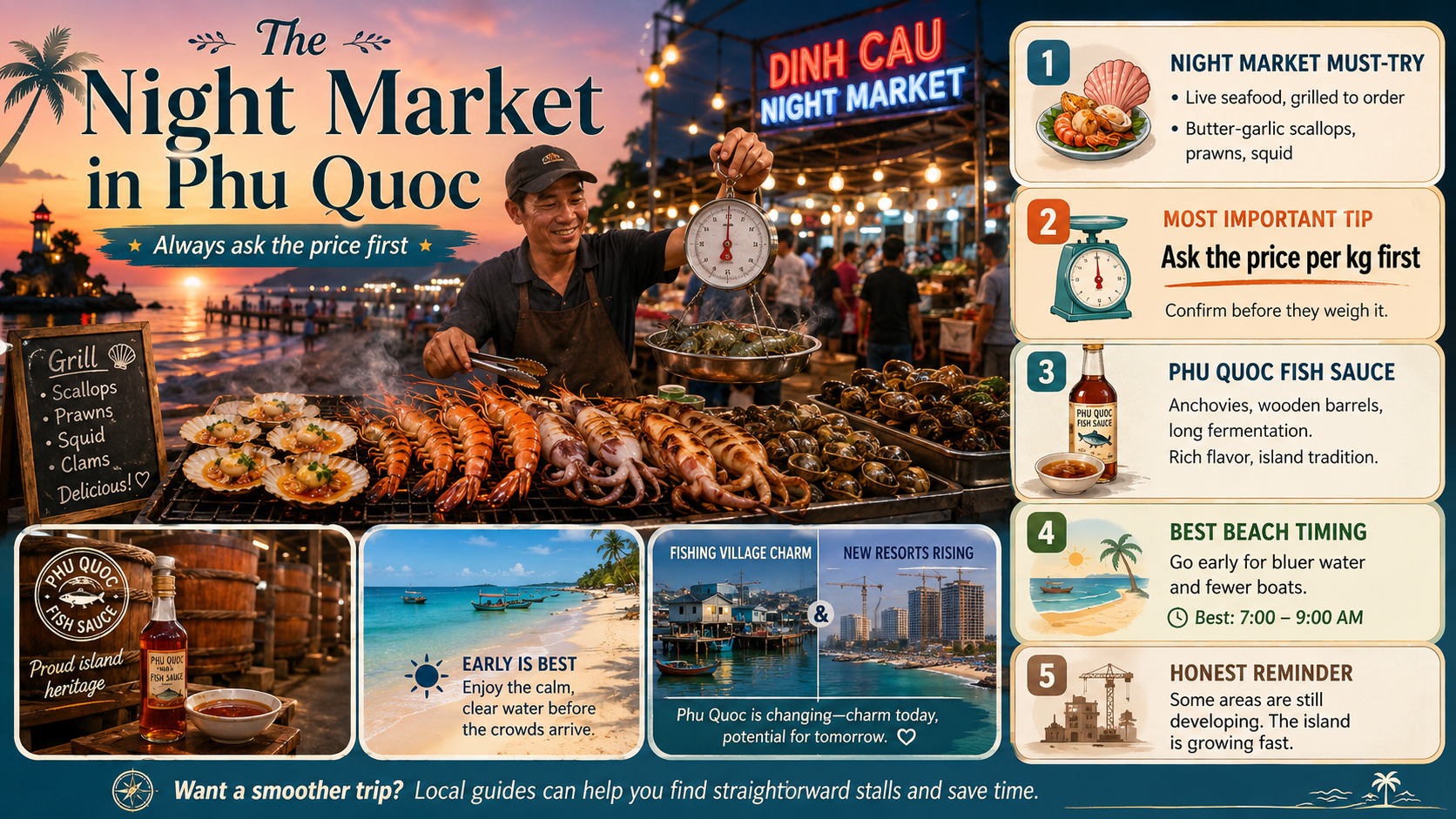
The grills at Dinh Cau Night Market in Phu Quoc start smoking around 6pm, and by 7 the whole street smells like charcoal and butter-garlic scallops. Vendors line up tanks of live seafood — tiger prawns, scallops, squid, sea snails you've probably never seen before — and you point at whatever looks good, they weigh it in front of you, and ten minutes later it's back on a plate, grilled or stir-fried with garlic and chili.
It's genuinely one of the best ways to spend an evening on the island. It's also where I learned, the hard way, that you should always confirm the price per kilogram before they start weighing anything.
View Phu Quoc Guide Profiles→
The seafood is real. The pricing is where it gets messy
Most stalls post prices, but they're not always easy to spot, and at night, in a crowd, with a vendor already scooping your scallops into a basket, it's easy to skip the question. I didn't ask once, and the bill came out noticeably higher than the table next to me paid for what looked like the same order. This isn't universal — most vendors are straightforward — but it happens often enough that locals themselves will tell you: ask the price per kilo out loud, before anything gets weighed, every single time.
Phu Quoc's other claim to fame: the fish sauce
Phu Quoc nước mắm (fish sauce) is considered some of the best in Vietnam, made from anchovies fermented in wooden barrels for around a year, sometimes longer. It's saltier and more complex than the mass-produced versions, and a few of the old production houses near Duong Dong town let you walk through and smell the barrels yourself — which is its own experience, since the smell is strong enough that you'll know you're close before you see the building.
What the beach photos don't show you
Phu Quoc's water is the kind of clear blue you see in the photos, especially around Sao Beach and the southern islands — but the most photogenic spots get crowded with day-trip boats by late morning, and trash occasionally washes up after windy weeks, which nobody puts in their Instagram caption. If you want the water looking like the photos, go early, before the boats arrive, or pick a quieter stretch of beach further from the main tourist piers.
One more honest note
Phu Quoc has grown fast over the past several years, and parts of the island now feel more like a construction site than a tropical escape, with resort developments going up next to older fishing villages. It's not all postcard scenery — some areas are genuinely still rough around the edges. That contrast is part of what makes it interesting right now, but it's worth knowing before you arrive expecting an untouched island.
If you'd rather not learn the "ask the price first" lesson yourself, the local guides at Springuu know which night market stalls are straightforward and which ones to watch closely — the kind of thing that only comes from actually living there.
View Local Guides
Guide Prices
English-speaking Guides
Frequently Asked Questions
Is the seafood at Phu Quoc's night market expensive?
Prices vary by stall and season, and are usually charged by weight — always confirm the price per kilogram out loud before the vendor weighs your order, since this is the most common spot for overcharging.
Is Phu Quoc fish sauce really better than other Vietnamese fish sauce?
It has a strong reputation for quality due to longer fermentation times and traditional wooden-barrel methods, though "best" is ultimately a matter of taste.
Is Phu Quoc's beach water actually that blue?
Yes, especially around Sao Beach, but popular spots get crowded with boats by late morning, so early mornings give you the clearest water and fewest people.
Is Phu Quoc still worth visiting with all the construction?
Yes, but go in with realistic expectations — parts of the island are still developing, alongside older fishing villages, so it's not a uniformly untouched paradise.
阅读更多: Cash or Card in Vietnam: What Actually Works, and Where You'll Get Stuck