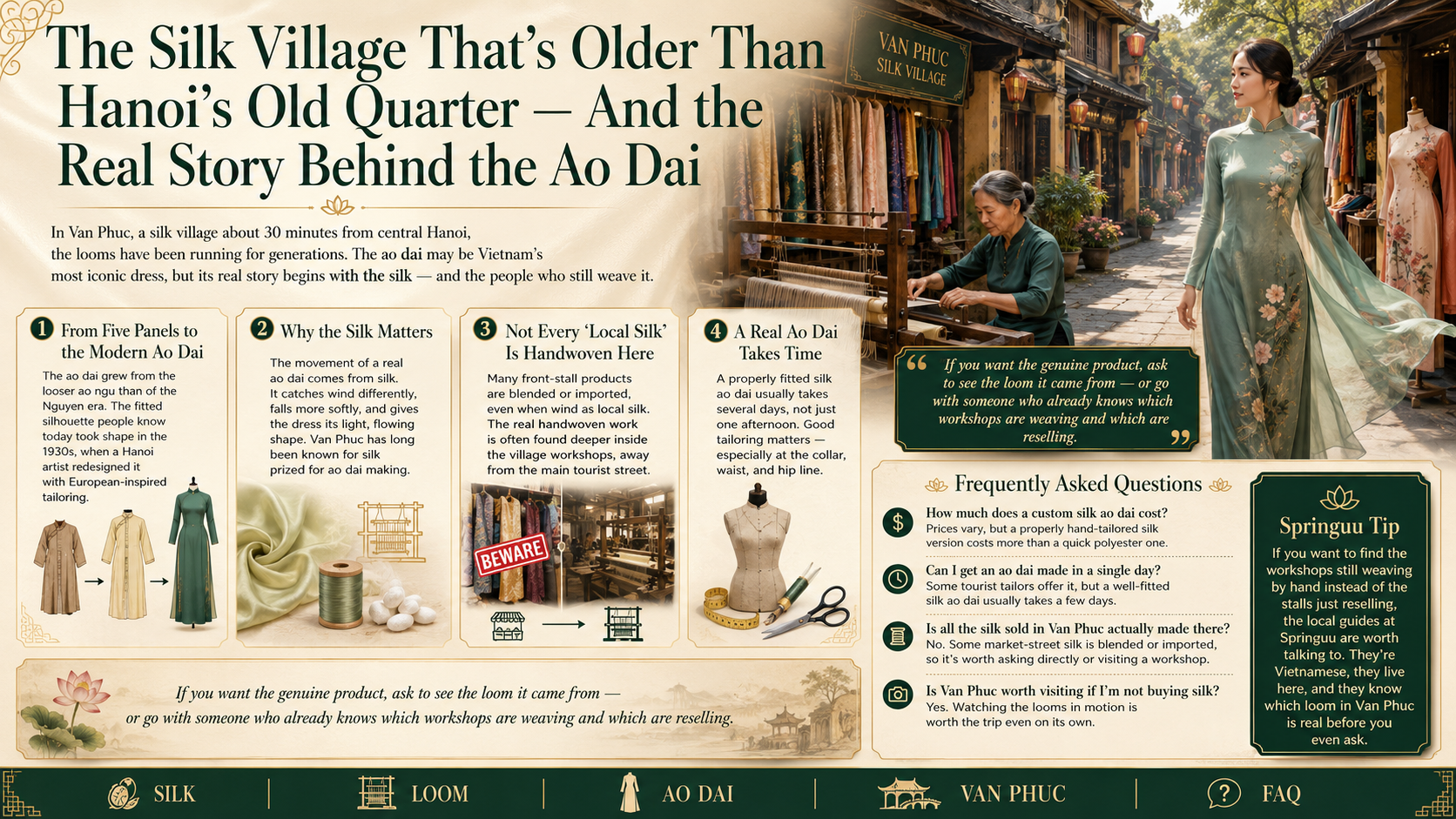
The loom clacks in a rhythm that doesn't stop for conversation — thread over thread, foot pedal down, shuttle through. In a narrow workshop just off the main road in Van Phuc, a silk village about thirty minutes from central Hanoi, an older woman doesn't look up while she talks to me. She's been doing this since she was a teenager, and the village itself has been weaving silk for, depending on who you ask, close to a thousand years.
I came here looking for the story behind the ao dai, the long tunic-and-trouser dress that's become Vietnam's most recognizable piece of clothing. The dress gets all the attention. The fabric, and the people who make it, mostly don't.
View Ha Noi Guide Profiles→
From Five Loose Panels to One Fitted Silhouette
The ao dai's ancestor, ao ngu than, was a looser, five-panel robe worn during the Nguyen Dynasty, when court dress codes were first standardized in the 18th century in Hue. The shape most people picture today — fitted at the waist, slit at the hips, worn over flowing trousers — didn't really exist until the 1930s, when a Hanoi-based artist redesigned it with European tailoring influence, adding darts and a closer cut. People called the style 'Le Mur,' a half-French pun on his own name. It was controversial at the time; some thought it scandalously form-fitting. Within a couple of decades it had become the version everyone now thinks of as traditional.
The Fabric That Gave the Dress Its Movement
None of that tailoring history would matter without the silk. A stiff cotton ao dai doesn't move the way a silk one does — it doesn't catch the wind the same way, doesn't fall the same way when someone walks. Van Phuc's weavers have made several types historically prized for ao dai, including a lightweight, almost translucent variety. Walking between workshops, you can hear the difference in the looms before you see the difference in the cloth — older wooden looms producing a slower, heavier clack, newer semi-automated ones running faster and quieter.
Not All the Silk in the Market Is From Here
This is the part worth saying plainly, because it's the kind of thing a guidebook glosses over: Van Phuc's market street is lined with stalls selling scarves and fabric labeled as local silk, and locals themselves will tell you, if you ask directly, that a good amount of what's sold today is blended or imported rather than hand-loomed in the village. It doesn't mean the craft is gone — workshops further back, away from the main tourist street, are still weaving the real thing — but it does mean a casual shopper wandering through can't assume every silk scarf on a rack came off a Van Phuc loom. If you actually want the genuine product, ask to see the loom it came from, or go with someone who already knows which workshops are weaving and which are reselling.
Why a Real Ao Dai Takes Longer Than a Souvenir Shop Suggests
A hand-tailored silk ao dai, measured and fitted properly, usually takes several days, not the same-afternoon turnaround advertised in some tourist-heavy towns. The fitting matters more than people expect — a poorly cut ao dai sits wrong at the collar and bunches at the hip, and you only really notice once you've seen a well-made one on someone who knows how to wear it.
Frequently Asked Questions
How much does a custom silk ao dai cost?
Prices vary widely depending on the silk and the tailor, but a properly hand-tailored silk version generally costs more than a quick polyester one — budget more if you want the real fabric and a proper fitting.
Can I get an ao dai made in a single day?
Some tourist tailors offer same-day service, but a genuinely well-fitted silk ao dai usually takes a few days for proper measuring, cutting, and fitting.
Is all the silk sold in Van Phuc actually made there?
Not necessarily. Locals acknowledge that some of what's sold on the main market street is blended or imported rather than hand-loomed in the village, so it's worth asking directly or visiting a workshop rather than just buying from the front stalls.
Is Van Phuc worth visiting if I'm not buying silk?
Yes — walking past the open workshops to watch the looms in motion is worthwhile on its own, even if you leave without buying anything.
If you want to find the workshops still weaving by hand instead of the stalls just reselling, the local guides at Springuu are worth talking to — they're Vietnamese, they live here, and they know which loom in Van Phuc is real before you even ask.
View Local Guides
Guide Prices
English-speaking Guides
Read more: One Night in Saigon: A Business Traveler's Secret Itinerary