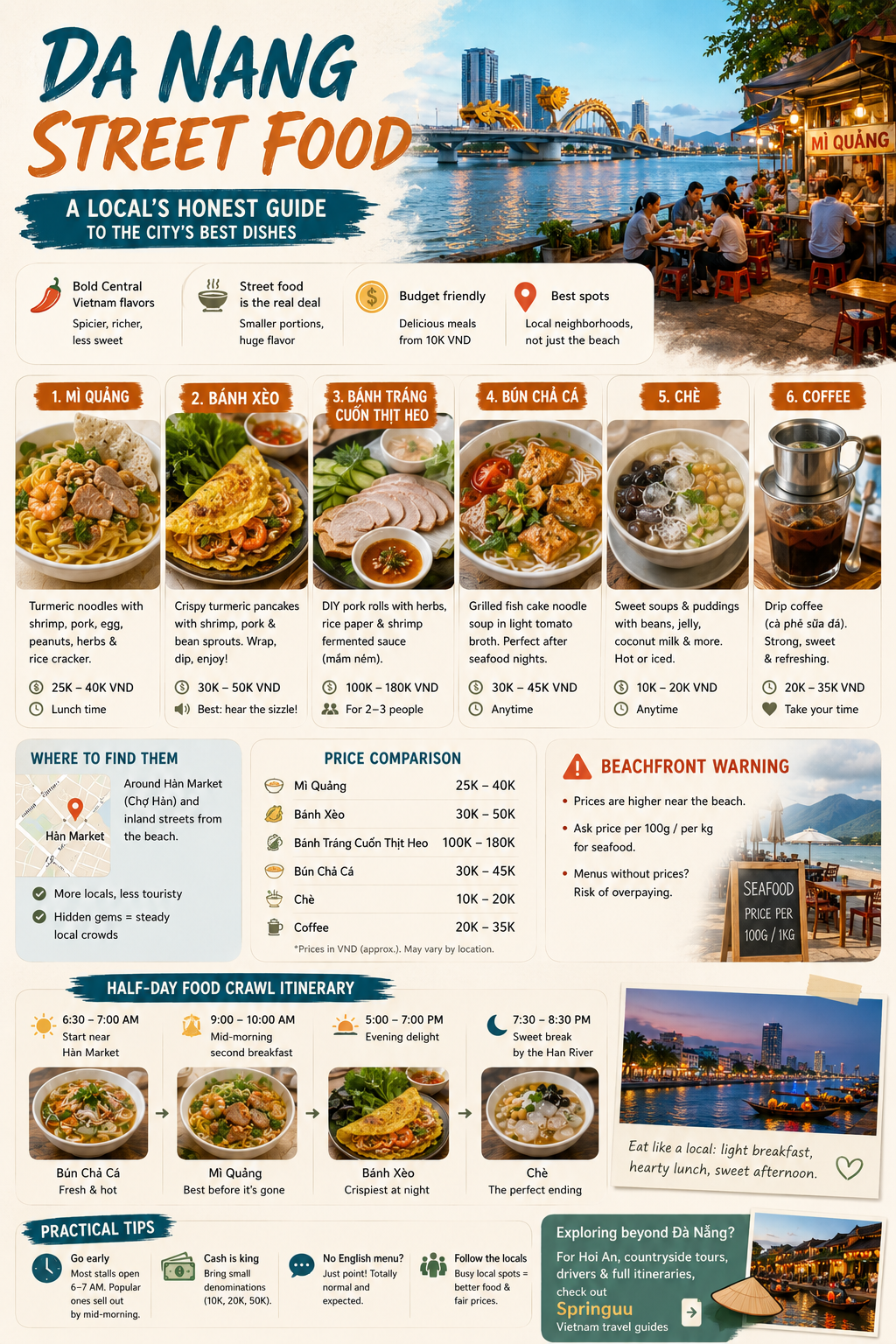
Most people who fly into Da Nang go straight for the beach, and it's easy to see why — the stretch of coastline along Vo Nguyen Giap Street is genuinely beautiful. But the food scene a few streets back from the sand is where the city actually shows its character, and it's a shame how many visitors leave without trying more than a hotel breakfast buffet and one seafood dinner by the water.
This guide walks through the dishes locals in Da Nang actually eat on a regular Tuesday, with realistic price ranges, timing tips, and a few honest warnings about where things can go wrong for first-time visitors.
Da Nang street food at a glance

Why Da Nang's food scene is different from Hanoi or Saigon
Da Nang sits in central Vietnam, and central Vietnamese cooking tends to be spicier and more intensely flavored than the north, but without quite the same sugar-forward sweetness you find further south. Fish sauce, shrimp paste, and chili oil show up constantly, and portions at street stalls tend to be smaller and cheaper than what you'll find in touristy beachfront restaurants. If you've eaten in Hanoi or Ho Chi Minh City before, expect the flavors here to hit a bit harder.
Mi Quang: the noodle dish that defines the region
Mi Quang is arguably the most iconic dish from this part of Vietnam — turmeric-yellow rice noodles served in a small amount of rich, peanut-flecked broth rather than a full soup, topped with shrimp, pork, a hard-boiled egg, and a rice cracker (banh trang) on the side for scooping. The broth is intentionally shallow, so don't expect a Pho-style bowl. A serving typically runs about 25,000 to 40,000 VND (roughly 33,000–52,000 VND at a touristy spot), and it's most commonly eaten for lunch rather than breakfast.
Banh Xeo: crispy turmeric pancakes off a hot griddle
These sizzling rice-flour pancakes get their yellow color from turmeric and are filled with shrimp, pork, and bean sprouts, folded over and served with a mountain of fresh herbs and lettuce for wrapping. You tear off a piece, wrap it, dip it in a sweet-and-sour fish sauce dip, and eat it by hand. Expect to pay around 30,000 to 50,000 VND for a plate of a few pancakes at a proper local spot. The best versions are found at stalls where you can hear the sizzle from the street — that sound is basically a quality signal.
Banh Trang Cuon Thit Heo: the DIY roll-your-own experience
This is less a single dish and more an assembly project: thin slices of boiled pork belly, rice paper sheets, herbs, cucumber, and a specific fermented shrimp dipping sauce called mam nem, all brought to your table so you build your own rolls. It's messy, hands-on, and genuinely fun to eat with a group. A full set for two or three people usually costs somewhere between 100,000 and 180,000 VND depending on how much pork is included.
Bun Cha Ca: the fish cake noodle soup near the coast
Given Da Nang's coastal location, it makes sense that fish cake shows up everywhere, and this noodle soup made with grilled or fried fish cake in a light tomato-tinged broth is one of the best examples. It's lighter than most of the other dishes on this list, which makes it a good choice if you've had a heavy seafood dinner the night before and want something gentler. A bowl typically costs 30,000 to 45,000 VND.
Che: the sweet endings locals actually order
Che refers to a whole family of Vietnamese sweet soups and puddings, usually made with mung beans, sticky rice, coconut milk, or grass jelly, served either warm or over crushed ice depending on the season. Da Nang has several long-running che stalls near the Han River where a bowl runs about 10,000 to 20,000 VND. It's an easy, low-commitment way to sample local flavors between bigger meals.
Coffee culture: where to actually sit down
Central Vietnam takes its coffee seriously, and Da Nang has a growing scene of small, independently run cafes rather than chains, many with balconies overlooking the river or the beach road. A basic drip coffee with condensed milk (ca phe sua da) costs around 20,000 to 35,000 VND, noticeably cheaper than the beachfront cafes aimed squarely at tourists, where the same drink can run two to three times as much for the view.
Where to actually find these dishes: a rough food map
The area around Han Market (Cho Han) and the streets just inland from the beach tend to have the highest concentration of genuinely local food stalls, since this is where residents themselves shop and eat rather than where the beachfront hotels are clustered. Walking distance from the market, you'll find several unmarked or minimally signed mi quang and banh xeo stalls that don't show up prominently in review apps but do steady local business, which is usually the better signal of quality than a five-star rating aimed at tourists.
An honest warning about beachfront pricing and pushy service
The restaurants directly facing the beach and the main tourist strip are convenient, but prices there can run noticeably higher than a few streets inland, and it's not unusual for menus without listed prices to result in an inflated bill for seafood dishes sold by weight. It's worth asking the price per 100 grams or per kilogram before ordering anything seafood-based, especially at stalls that cater heavily to tour groups, since this is one of the more common ways visitors end up paying far more than locals would for the same meal — the same "confirm the price first" rule covered in common first-time Vietnam mistakes applies just as much here.
A half-day food crawl you can actually follow
If you only have one morning to dedicate to eating your way through the city, a workable order is to start around 6:30 or 7 a.m. near Han Market with a bowl of bun cha ca while the broth is still freshly made, then walk a few blocks to find a mi quang stall for a mid-morning second breakfast around 9 or 10 a.m., since by then the market crowd has thinned out and you can usually get a seat right away. Leave banh xeo for the early evening, since the best versions are cooked fresh to order in small batches and tend to taste better hot off the griddle than sitting under a heat lamp during the day. Between meals, a short walk along the Han River gives your stomach some room before the next stop, and it's also where you'll find several of the long-running che stalls mentioned earlier if you want a sweet break.
This kind of loosely scheduled eating crawl works better than trying to hit every dish in a single sitting, both because portions add up faster than you'd expect and because several of these stalls are genuinely at their best only within a narrow window of freshness. Locals structure their own eating day this way — a light breakfast, a heavier lunch, and something sweet or light in the afternoon — rather than treating every meal as a full sit-down occasion.
Practical tips before you go
Most local food stalls open early, around 6 or 7 a.m., and popular ones for dishes like mi quang or bun cha ca often sell out by mid-morning, so don't assume you can roll in for a late brunch and get the freshest version. Cash is still the default at street stalls, so carry small denominations, and don't expect English menus outside of the main tourist zones — pointing at what someone else is eating works just fine and is a completely normal way to order.
If you're planning to explore beyond Da Nang's food scene into nearby Hoi An, or continuing on to Hue's imperial sites over the Hai Van Pass, and want help structuring a multi-day itinerary or arranging a driver who actually knows the area, Springuu's Vietnam travel guides cover more detailed regional planning.
Frequently Asked Questions
Is Da Nang street food safe for first-time visitors to Vietnam?
Generally yes, especially at stalls with high turnover where food is cooked fresh in front of you, but it's smart to ease in gradually with cooked soups and noodle dishes before trying raw or fermented items, particularly in your first day or two while your stomach adjusts.
Do I need to speak Vietnamese to order at local stalls?
No — most vendors are used to tourists pointing at menu photos or gesturing toward another table's order, and this is a completely normal and accepted way to order food throughout the city.
How much should I budget per day for street food in Da Nang?
A realistic daily budget covering several meals plus coffee and a sweet snack typically falls between 150,000 and 250,000 VND per person, which is noticeably cheaper than eating at beachfront restaurants aimed at tourists.
Is Mi Quang the same as Pho?
No — Mi Quang uses turmeric-colored noodles served in a small amount of concentrated broth rather than a full soup, and it originates specifically from the central Quang Nam region around Da Nang and Hoi An, while Pho is a northern Vietnamese dish with a much larger, clearer broth.
What's the biggest mistake tourists make with Da Nang food?
The most common one is ordering seafood by weight at beachfront restaurants without confirming the price first, which can lead to a bill far higher than expected — always ask the per-kilogram or per-100-gram price before agreeing to an order.
Read more: