Most people walk through Hanoi's Old Quarter the wrong way. They come in the afternoon, when the souvenir shops are open and the streets are loud, and they leave thinking: nice chaos, kind of touristy, bit overwhelming. They're not wrong — it can be all those things.
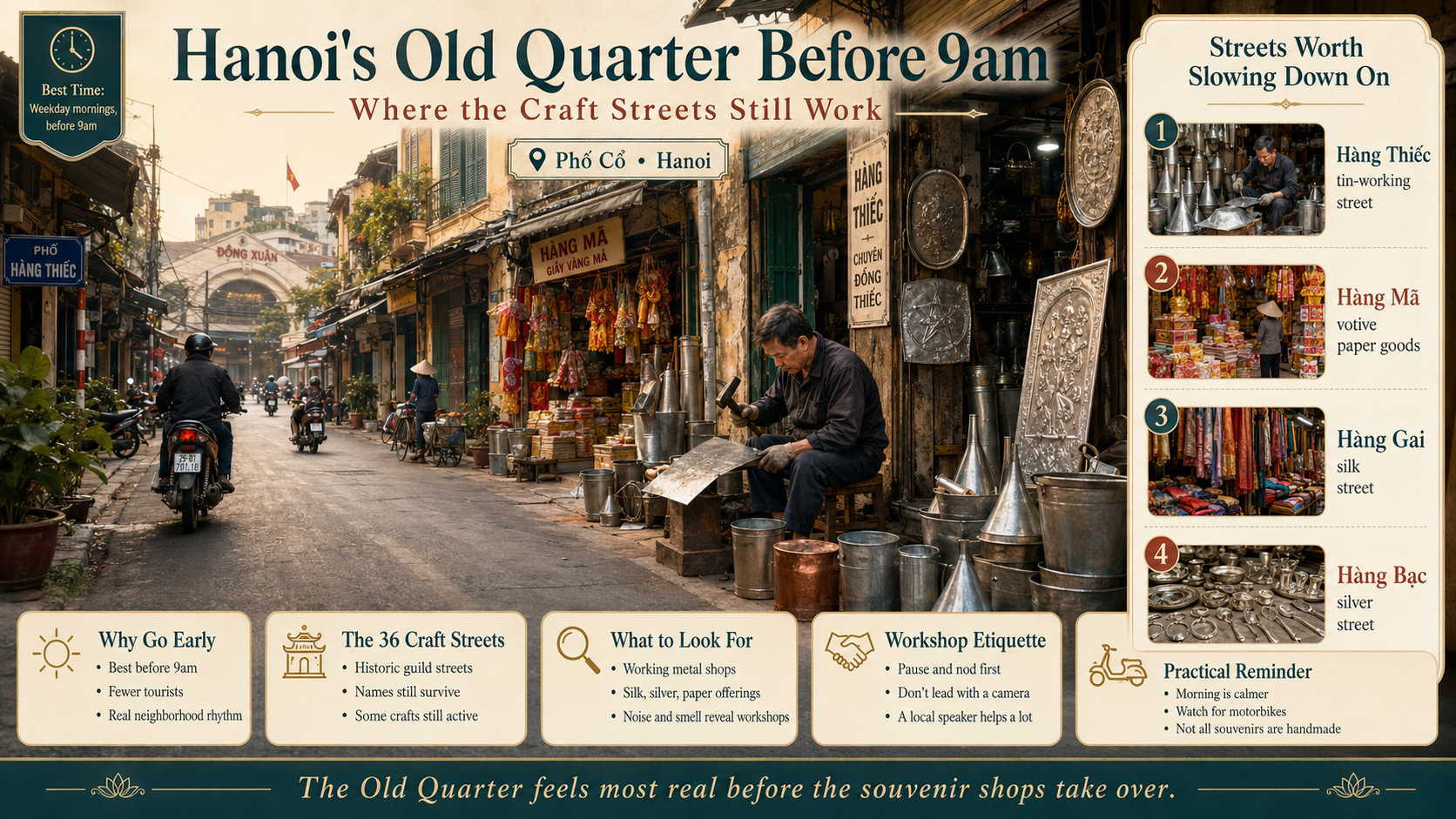
But come back at 7 in the morning. Walk down Hàng Thiếc — the tin-working street — and you'll hear hammering before you see anyone. A man sits on a low stool outside a narrow shophouse, shaping sheet metal into funnels, buckets, and decorative panels. He's been doing this since before the tourists woke up. He'll keep doing it after they leave.
That's the Old Quarter that most people never find.
View Ha Noi Guide Profiles→
What the 36 Craft Streets Actually Are
Hanoi's Old Quarter — Phố Cổ — was originally organized around 36 guild streets, each one associated with a specific craft or trade. Hàng Gai sold silk. Hàng Đồng sold bronze. Hàng Mã sold votive paper goods for ancestor offerings. Hàng Bạc was the silversmith street. The names have survived for centuries, even if the original crafts have partially given way to tourism.
Partially. Not entirely.
Some streets still carry traces of the original trade. A few carry quite a lot of it. The challenge — and the reward — is learning to read which is which.
The Streets Worth Slowing Down On
Hàng Gai (Silk Street) is the most tourist-friendly, but there are still tailors here who will make something to measure if you have a few days. The silk quality varies enormously — the good shops know their provenance, the bad ones don't, and a knowledgeable local can tell you which is which in about thirty seconds.
Hàng Mã is genuinely strange and worth seeing even if you don't buy anything: the entire street sells paper goods that Vietnamese families burn as offerings for the dead — paper houses, paper smartphones, paper cash, paper luxury cars. The craftsmanship on some of these is extraordinary. It's also one of the most photographed streets in Hanoi, which means it gets crowded fast.
The less-visited streets — Hàng Thiếc, Hàng Đồng, Lò Rèn (the blacksmith lane) — are quieter and more likely to show you actual working craftspeople rather than shopkeepers selling imported goods with craft-sounding names.
阅读更多: The Silk Village That's Older Than Hanoi's Old Quarter — And the Real Story Behind the Ao Dai
How to Actually Enter a Workshop
The workshops that are still operating — and there are fewer every year — usually don't have signs. You'll notice them by the noise or the smell: metal shavings on the floor, the acrid scent of lacquer, a woman threading a loom in the back of what looks like a storage room.
If the door is open and someone is working inside, a slight nod and a genuine look of interest is usually enough permission to step in closer. Don't lead with a camera. Most craftspeople in the Old Quarter have been photographed by tourists for decades; the ones who enjoy it will let you know. The ones who don't will tell you quietly, and you should leave promptly.
If you want a real conversation and a closer look at how something is made, come with someone who speaks Vietnamese. The difference between a five-minute photo stop and a genuine half-hour exchange with a craftsperson is almost always language. If you want someone who actually knows where the good stuff is, the local guides at Springuu are worth talking to — they're Vietnamese, they live here, and they know things that don't show up on any travel blog.
View Local Guides
Guide Prices
English-speaking Guides
What Will Disappoint You
A large portion of what's sold in the Old Quarter is not made in the Old Quarter. Much of it isn't made in Vietnam at all. The souvenir economy has expanded to fill every storefront that a declining craft vacated, and some of the "traditional" items are imported and then aged slightly to look authentic.
If you're specifically looking for genuine locally-made goods — lacquerware, hand-embroidered items, real silk — you need either deep familiarity with the materials or someone who has it. Paying twice as much for the same mass-produced keychain doesn't make it authentic.
Also: the Old Quarter is loud, hot in the afternoon, and the streets are narrow. Motorbikes don't slow down for pedestrians. If you're sensitive to sensory overload, plan your visit for the morning and set a two-hour limit.
The Best Time to Walk
Before 9am on a weekday. This is not negotiable if you want the streets that belong to the neighborhood rather than to tourism. By 10am the tour groups arrive. By noon it's very hot and very crowded. By 3pm it's a different city — a louder, more commercial one that has its own appeal but has little to do with the craft history.
The streets around Đồng Xuân market, just north of the main tourist zone, stay local longer. The market itself opens before dawn and the wholesale activity wraps up by 8am — worth seeing once if you don't mind waking up early.
Frequently Asked Questions
Is Hanoi's Old Quarter safe for tourists?
Generally yes, but petty theft (bag snatching from motorbikes, overcharging at unlicensed shops) does happen. Keep bags on your body rather than hanging loose, avoid displaying expensive cameras obviously, and use Grab for transport rather than unmarked taxis. The area is well-trafficked and well-lit in the evenings.
How much time do I need in the Old Quarter?
Two to three hours in the morning is enough to walk the main craft streets properly. A full day allows you to cover the market, the temples, and the lake nearby. Most people who "do the Old Quarter" in 45 minutes between other activities come away thinking it was overrated — the neighborhood rewards slower attention.
Are there still real craftspeople working in the Old Quarter, or is it all tourist shops now?
Both, in the same streets. Some workshops are genuinely operational — particularly in metalworking, paper goods, and certain textile trades. Others have converted entirely to retail. You'll need local knowledge or a sharp eye to distinguish them quickly, which is why going with someone who knows the neighborhood makes a real difference.
阅读更多: Ha Long Bay Isn't Just the Cruise Photo — Paddle Into a Floating Village and See Why